As with the other At Home Care pages, I will start from infancy and work my way up
to older children. You should discuss any of these ideas with your physical therapist to
determine if they are appropriate for your child before trying them. There are a lot
of subjects to cover in mobility - the first part of the page are items that are used to
get them walking, and then at the end are strollers and wheelchairs. Remember, each child is
different and your child may need some, all, or none of these items.
Bouncer
It can be quite difficult to
come up with ways for children to learn how to bear weight on
their legs when they can't even lift their head off the floor.
For the largest headed children it can be two or three years
before they can stand up for long enough to make a difference.
Normally children start bearing weight for long periods by 10
months. Bones grow in direct proportion to the amount of weight that
they have to bear, if they don't bear weight then they will
often become stunted. To prevent this we started trying to find
ways for Owen to bear even a little bit of weight early on.
The first thing that we did was to modify one of those door
frame jumpy bouncers. I added supports to the top so that he could rest his head comfortably
while he bounced. He learned to push down with his feet so that he had some
weight bearing and he also figured out that he could make his body move using his feet.
You can see the details on how I made this item here.
We put different things under his feet to keep it interesting for him. We put down
bubble wrap (as seen above), soft blankets or anything else that might be
stimulating. Owen loved spending time in here and continued to use it until his weight made it
unsafe. The video was made when he first started in the bouncer, within a few short weeks
he was really making it go! We started with the bouncer at about 10 months old.
After Owen started in the bouncer he grew a full two inches in the next month, and part
of that was probably due to the weight bearing that it allowed him to put on
his legs. It was a good start, however the bouncer still didn't let him put full weight
on his legs.
At about 14 months old, the next step was to get a stander to get him fully upright.
We opted for the Lecky Squiggles stander because it could lay down completely
flat to put the child in, and then had a pneumatic lift to raise him up to standing. It
also looked very comfortable and it had really good head support, and the mobility base made
it possible to roll him around the house and let him experience different environments in
an upright position. There were two downsides to this stander however. The first was that
even though Owen met the minimum height requirement, he legs were so short in proportion to
his body that we had to make a wooden block for him to stand on. The second was that although
it came with a tray, it was useless when the stander was configured down to it's smallest
size and we had to use a tray that I made for him. Otherwise it was a very comfortable and
easy to configure stander. There are a hundred other makes and models of standers out there,
if you have one to recommend send me the info here.
Baby Walker
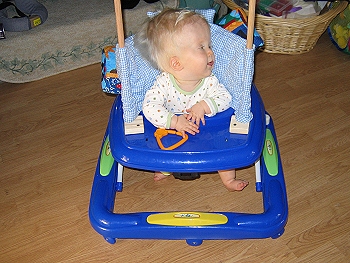
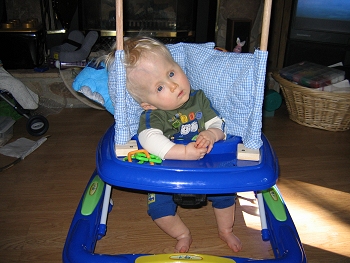
At about the same time as we got the stander, we decided to find a way to start letting him
move independently. As he was still very small for his age, I was able to modify a baby walker
to start with:
I added some poles to attach some head support, a strap around his chest to support his trunk and
some cushions to position him. You can read the details on making this item
here. This worked reasonably well. It took him
several weeks of sitting in it and then me finally putting bubble wrap under his feet from him
to get the idea of putting his feet down and pushing it to move. It took many, many months
for him to build up the strength to move it more than a foot or two at a time and with this
model that is as far as we got, but it was a good start.
Bigger Boy Walker
You can see below that our first attempt with a commercial walker
didn't go very well so I decided to try and
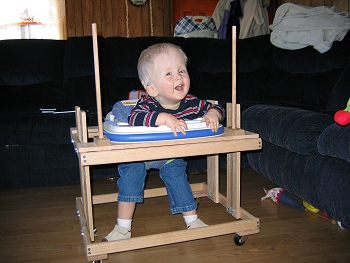
make my own. I took the bouncer and used it to
make a seat in a new walker when he was just over two years old.
It originally had poles and a head support much like the bouncer had, but by the time I actually
finished construction he no longer needed them. In the end I just took off the poles altogether.
This walker was the greatest. The first wheels I used provided almost no resistance at all so
he quickly got the idea of really moving around for the first time. He was able to
manuever it through narrow doorways and complete freedom to move about the main floor as he wished.
Eventually I changed the wheels to something with more resistance to help him build leg
strength. He used this walker for over a year before he finally learned how to crawl enough to
start moving around on his own, and even then he used it for another year from
time to time before he could crawl on all fours and pull himself to stand without it.
Commercial Walkers/Gait Trainers
Once you get up to this level of commericial walker there are once again, seemingly
hundreds of choices. I'm going to cover a few of the more popular ones
here. Walkers range from very simple frames that just provide a bit
of extra help in balancing to ones that provide almost full body
support.
The first thing we tried was a Rifton Pacer Gait Trainer. It seemed nice in
concept, but it never worked out for us. The first thing was that it just provided too much resistance
to motion for his legs to move. You can adjust the resistance up and down, but even at its
lowest setting he couldn't manage it well. The other problem is that it has a lot of
steel out in front. This meant that even when he did move it he couldn't roll up to
anything and work because he was too far away. Also, he is sitting on what us old timers
who had bikes in the 70's call a banana seat. It was just too wide and kept his legs spread
apart too far to be effective. All in all it was a failure for us, but
I know that it is a popular first choice for kiddos.
If the child just needs a bit of help with balance and stability then
a popular choice is the Kaye Walker which is being modeled below by
Cayman:
My Owen needs a bit more help with hip strength and stability than
the Kaye can provide, so we have a Snugseat Crocodile with a sling
seat to begin with and a fold down bench seat for later.
It is also supposed to have
a chest strap which was on backorder when we took this picture. It
has lateral torso supports and a headrest to keep him from throwing back
his head. You can remove the items you don't need as the child's
strength grows. It is also a fairly compact item when it is folded.
We are fond of the sling seat (a fabric harness type seat) which is comfortable and supportive.
Another popular choice due to its flexibility is the KidWalk. It can
be configured as a fairly simple walker with minimal supports, or
it can have all of the supports that the Crocodile does, plus a few
more. Below is Miles in his KidWalk:
Infant Strollers
There are no special needs infant strollers that I know of. If you
do and can recommend one, please send me the info
here. Generally the
best thing that you can do is to find one that allows the child to
lay flat. That way if they cannot support their head in a seated position
they can rest comfortably for longer periods of time. I also found that
since he spent so much time in the stroller that it was worth upgrading
to one of the jogging strollers that had the big tires - the little
plastic tires on your standard stroller can really give the kids a jolting
when going over grass or other uneven ground and that can really make
a big head roll around when they are laying down.
Wheelchairs
If your child cannot walk when they outgrow their infant stroller then you'll need to
upgrade to something a bit bigger and a bit more heavy duty. Once again there are a lot
of choices available out there and I'm just going to cover a few of them.
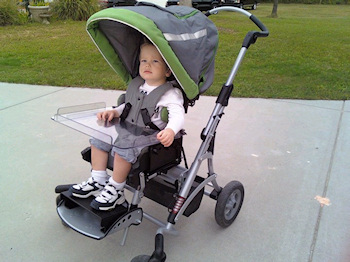
To begin with we have the choice that we made, which is the BINGO IUS stroller.
This is an awesome stroller/wheelchair, but the big bummer is that it is no longer available in the
United States. It's made in Germany and the only US distributor has stopped selling it. So if
you are in Europe and reading this, you can still buy it from Hoggi.
I will tell you what features
it has that we needed though, and a similar stroller that you can still buy in the US. We
had very specific needs in a stroller. The first was that it had to fully recline. Owen
has belly issues if he sits upright all day and since we can spend hours and hours sitting
in waiting rooms, he needed to be able to stretch out. There are very few models that can do this,
most can "tilt in space" meaning that the seat will lean back, but the legs will still be at
a 45 degree angle to the body. We also needed a tray because Owen can't sit up in a hospital
bed to eat, and he was getting too big for the highchairs at restaurants. Other important items
were an abductor (a pommel that sits between their legs to keep them from sliding down), it had
to collapse down to fit in my Honda Civic/Insight, it had to be liftable by the tiny little me
and I really wanted a solid back (rather than a short back and a headrest)
to help him stretch out and support his big head.
The Bingo had all of these features and it has been an awesome stroller. Since it is no
longer available in the US I have searched for a similar replacement to recommend and I found
the Thomashilfen EASys Stroller. It is a very similar stroller, though it doesn't have the
spring suspension that the Bingo does. Otherwise it has all the same features and a much nicer
choice of fabrics. Both of these strollers are completely configurable for seat depth and width
and all of that sort of thing, and in both cases you can turn the seat around to face you
while you are pushing the stroller. You can put this seat on an indoor high-low base
(one that you can adjust the height off the floor on) as
well.
If anyone has tried this stroller then please let me know how it worked out for you by
emailing me here.
Probably the most popular pediatric wheelchair is the Otto Bock Kimba. It isn't the easiest
to find the web page for this item because the default is Otto Bock of Europe where the
Kimba looks very much like the Bingo above. So, going against my better judgement of posting
links that will probably go dead in a few weeks, I'll try one and say click
here to
find it. We did not choose it because we didn't think that it could fully recline. The initial
looks on the website seem to indicate that it can only tilt, but I am told by Blake's (seen below)
Mom that you can order an add-on that will allow it to fully recline.
Like the other strollers mentioned above, the seat width, depth, footrest position and everything
else you can think of can be adjusted. This is why these things run from $2500 to $8000
or more depending
on the options you purchase so you will definitely be wanting to get your insurance company involved.
The Kimba can also be placed on a high-low base which you can see on the Positioning link on the
left menu.
Below you can see Blake modeling the Kimba on its
stroller base with the tray on the left and the rain cover on the right:
I also wanted to mention a newcomer to the market - the Leckey Squiggles Seating System.
It is shown on the Positioning link on the left menu on its high-low base. Below is the
Squiggles on its stroller base.
It has all the same sorts of options as the Kimba, but the cup shape of the fuller
seat back looks very comfortable.
Legal Disclaimer: While every effort has been made to make certain that the information contained in this website is accurate, it must be remembered that the content is managed by a parent, not by a doctor. Information contained here is for general support purposes only and is no substitute for the care of a physician.